
Training program for e-tutors
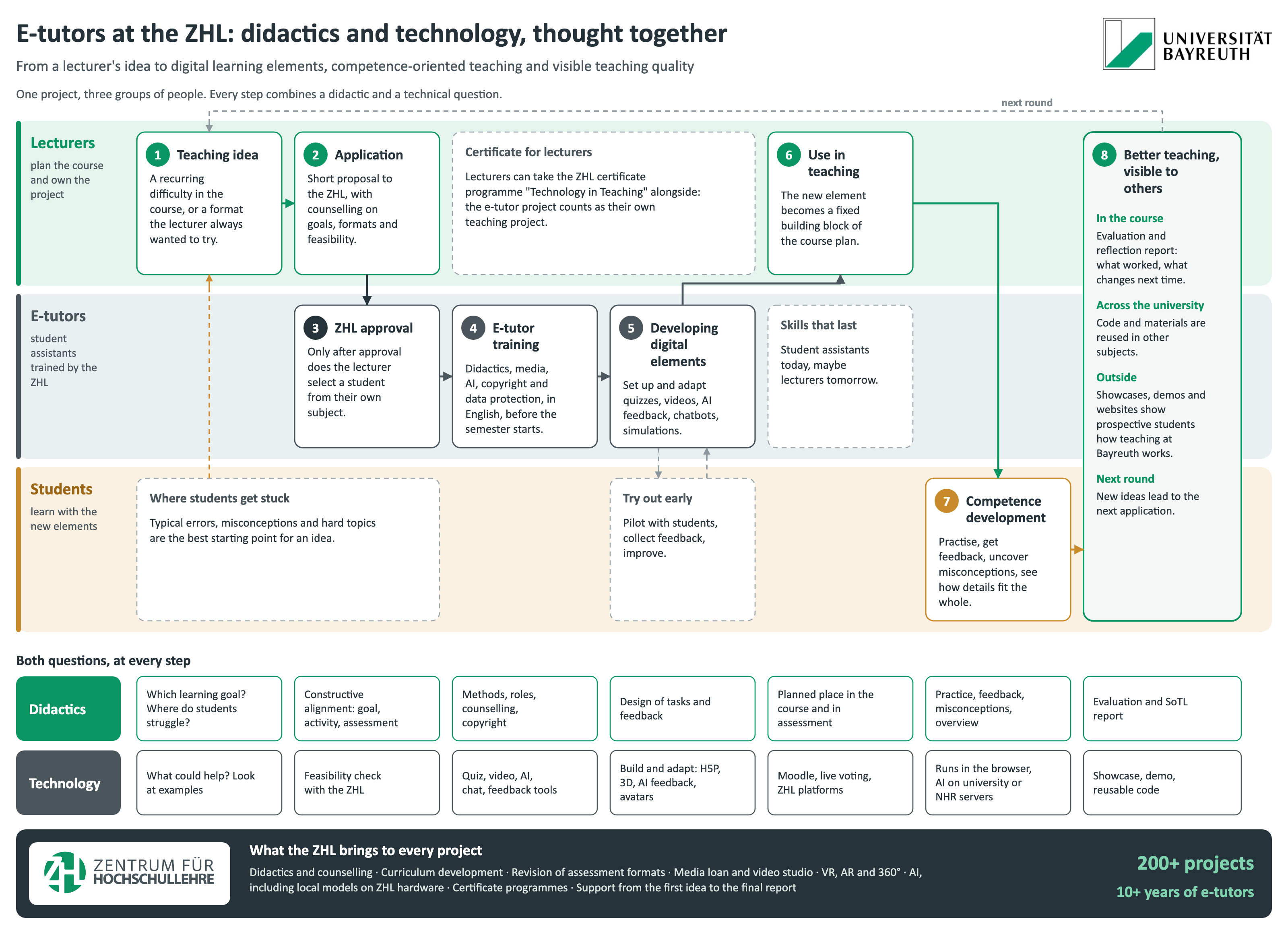
The Centre for University Teaching (ZHL) has trained student assistants as e-tutors every semester since 2017. They work at a chair for one semester and, together with the lecturer, carry out a concrete project for digital teaching: an interactive learning environment, a video series, a redesigned Moodle course or an AI tool for a specific course. The ZHL trains them, advises and supports the projects didactically and technically until they are in use in teaching. Our guiding principle: didactics and technology are thought together.
News and dates
In the summer semester 2027, the ZHL is funding the personnel costs of ten e-tutors for five months from the Bavarian university agreement (Hochschulvertrag). We warmly invite lecturers to apply. Further students can use the training free of charge. There are 20 training places per semester. The training at the ZHL is led by Paul Dölle. There are no costs for the chair. Please apply on our project-website on https://etutor.zhl-ubt.de
After approval, you select a student from your subject. New: in 2027 the training starts in March. The first training days are mandatory and take place before lectures begin, as hybrid on-site/online seminars. Your students register themselves for the course on ProfiLehrePlus.de. Since the winter semester 2025/26, the training has been held entirely in English.
Students must be enrolled for the entire programme (from March). Longer stays abroad during the project are not recommended.
Information session: Monday, 30 November, 13:05 to 13:55, for questions and exchanging ideas. Register on ProfiLehrePlus
Important links
What your chair brings
A course or topic you want to develop digitally, a contact person at the chair and the subject material (scripts, data, measurements, recordings). You do not need a finished technical concept: we work out together which format fits.
Training
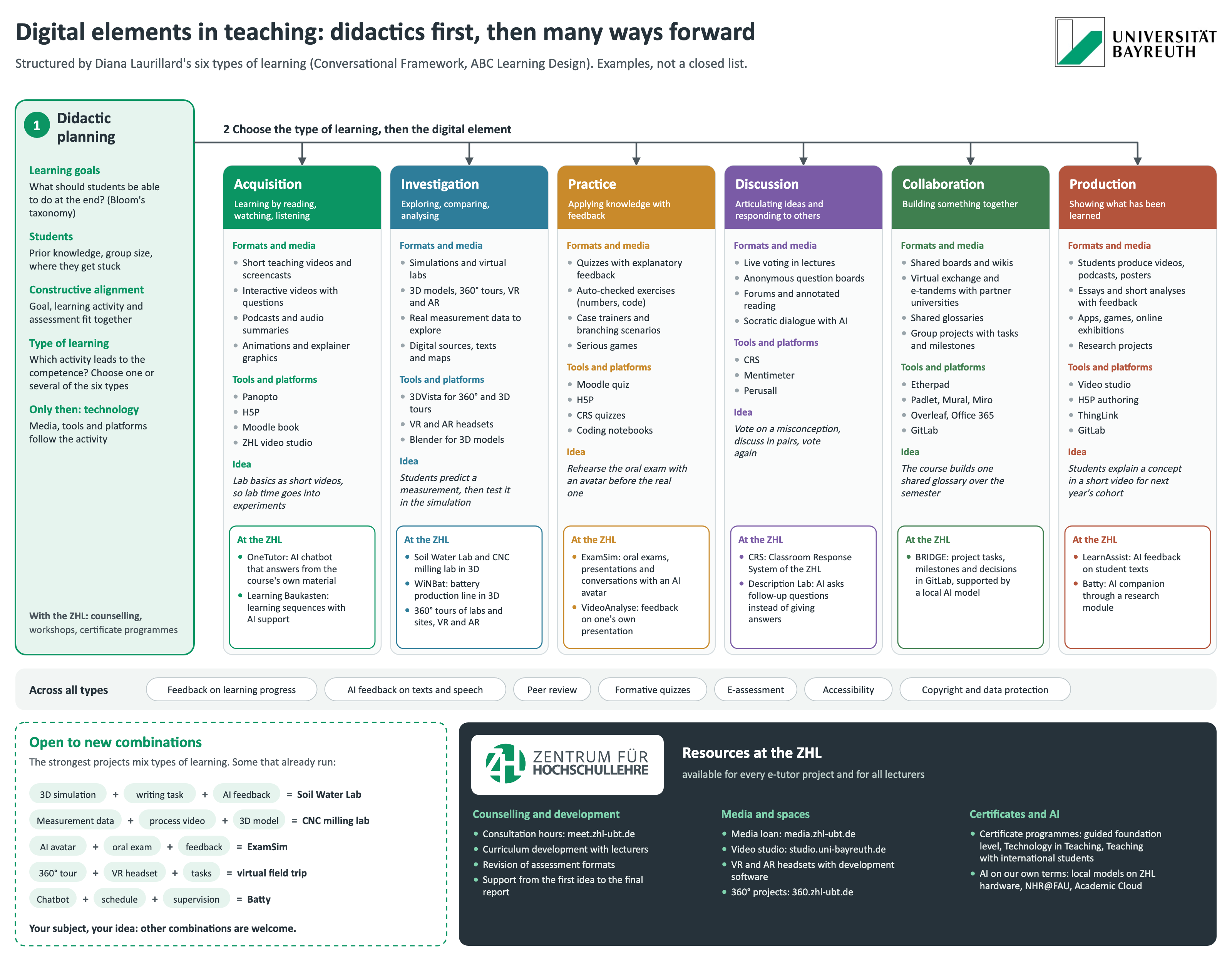
The training introduces teaching and learning formats and methods and shows how digital media, technologies and AI fit in. E-tutors weigh up advantages and disadvantages and can advise lecturers on their choice. They then carry out their own project, with regular exchange in the training group. Copyright and data protection are a fixed part of the training, and since 2023 so is the use of AI in teaching.
E-tutor competences in brief
- Advising on the selection and design of digital teaching and learning processes
- Designing and building interactive learning environments, for example simulations, 3D models, 360° tours, VR and AR scenarios or prepared measurement data
- Targeted use of AI in teaching and project work: feedback on student texts, conversation simulations with avatars, chatbots for guidance, locally hosted language models
- Live voting (ZHL Classroom Response System, Mentimeter) and other interactive formats for face-to-face sessions
- Producing teaching videos (screencasts, studio recordings, editing) and integrating them into Moodle, for example via Panopto or H5P [optional]
- Advising on copyright and data protection
- Testing with students and improving based on their feedback
Resources at the ZHL
Every e-tutor project, and every lecturer, can draw on the resources of the ZHL:
- Counselling and development: consultation hours (meet.zhl-ubt.de), curriculum development with lecturers, revision of assessment formats
- Media and spaces: media loan (media.zhl-ubt.de), video studio (studio.uni-bayreuth.de), VR and AR headsets with development software, 360° projects (360.zhl-ubt.de)
- AI on our own terms: local language models on ZHL hardware, NHR@FAU, Academic Cloud
- Certificate programmes: guided foundation level, Technology in Teaching, Teaching with international students
For lecturers: certificate programme
Lecturers can take the ZHL certificate programme “Technology in Teaching” alongside. It includes developing, running and evaluating a teaching project with technology integration, and the e-tutor project can serve as that project.
Contact
The ZHL team is happy to help you with your application and with advertising the position in your department. Please get in touch.
What e-tutors build at the ZHL: examples from current projects
- Conversation simulation with an AI avatar: Students practise putting things into words under pressure. They prepare for oral exams or train pitches, presentations, office-hour conversations and situations in a foreign language. Their counterpart is an interactive avatar driven by a multi-stage language model system, and after each conversation they receive feedback. We are currently considering extending the simulation to selection interviews. examsim.zhl-ubt.de
- Precise wording with AI feedback (biomechanics): In the “Description Lab”, students watch videos, images, animations or diagrams and describe in technical terms what they see. The AI marks vague passages and asks follow-up questions; students work out the answer themselves. The language model runs on the NHR@FAU computing cluster, and e-tutors can use the code as a basis for their own subjects and topics. biomechanik.zhl-ubt.de
- Soil physics (geoecology): On this basis, a learning environment was created that leads from taking a soil sample to measuring hydraulic conductivity. Sampling and the measurement set-up can be operated in 3D. At several points, students write predictions and explanations and receive feedback.
- Manufacturing technology (CNC milling): Measurement data from a real milling process (forces, power, process video) are synchronised in time and linked to a 3D model of the machine. Students see what happens in the workpiece while the measurement curves change.
- 360° tours, VR and AR: With 3DVista, the ZHL builds 360° and 3D tours of labs, sites and processes that students can explore on screen or with a VR headset. VR and AR headsets and the software to develop immersive learning scenarios are available at the ZHL. 360.zhl-ubt.de
- Battery management (chatbot “Batty”): A chatbot guides students through a research module. It helps them sharpen their research question and keep to their schedule. It does not write texts or award grades; that remains with the chair.
- Local AI for project management: A language model on ZHL hardware analyses the documents of an international project, such as minutes, task lists and deadlines, and turns them into tasks, milestones, responsibilities and documented decisions in the university’s GitLab. The project data stay at the university, and the model’s suggestions are adopted only after human review.
- Live voting in lectures (CRS): With the ZHL’s Classroom Response System, e-tutors develop questions for face-to-face sessions, support their use and analyse the results with the lecturer.
In AI projects, we agree with you at the outset which language model is used and where the data are processed: on ZHL hardware or at NHR@FAU.